Showing posts with label F. Scott Fitzgerald. Show all posts

Wednesday, May 02, 2012

Flappers And Fitzgerald


A new breed of woman appeared on the world scene in the years after World War I.
After the war, Amercan social liberalism filled a void left in post war culture and behavior.
The new breed of women wore short skirts, cut their hair short, drank, smoked, drove cars, and viewed sex as a recreational pursuit.
They listened to jazz and rebelled against the established behavioral norms of their elders. American jazz epitomized this new culture and it quickly spread to Europe. The word "jazz" was used to describe more than music; it meant anything exciting or fun. The women were called "flappers." Flapper was a slang word whose definition could mean a young prostitute or a lively teenage girl. It came to be accepted for an immature girl, scantilly clad, and frivolous.
The American flapper population and its rebelliousness was fueled in part by Prohibition. Back alley speakeasies were popular and the public flaunted Prohibition; they ignored the law by their open consumption of alcohol and living the social life of the speakeasies.
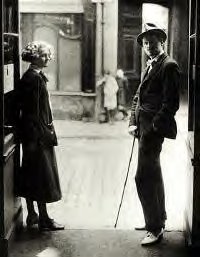
F. Scott Fitzgerald helped to glorify the flapper lifestyle and made flappers appear to be attractive, rebellious, and independent. His wife Zelda was a prototypical flapper. In '20s Jazz Age Paris, they immersed themselves in the lifestyle.
Flapper fashion was mostly a result of French fashion, especially that of Coco Chanel. In French, a flapper was called a garconne ("boy" with the feminine suffix). Girls looked young and boyish: short hair, flattened breasts, and straight waists. Women wanted to look fit, sporty and healthy.
This was the world of Hemingway's Paris, and his "Lost Generation" compatriots.
Photos six and seven are of Zelda Fitzgerald.
Pin It

Saturday, July 26, 2008

F.Scott Fitzgerald


F. Scott Fitzgerald was perhaps the most famous of the Jazz Age writers, (he supposedly coined the phrase himself). F. Scott Fitzgerald embodied the spirit of the Roaring Twenties. He staked his claim as the voice of his generation with his first novel, "This Side of Paradise" (1920), and later with "The Great Gatsby" (1925). The Saint Paul, Minnesota native spent a lot of time visiting Paris in the 1920's with his wife Zelda, and their daughter Scottie. Fitzgerald was a fan of Hemingway's early work and Hemingway loved "The Great Gatsby." Fitzgerald was to become a good friend (if a difficult one) of Hem's and the two had quite a few interesting and humorous moments in France. Fitzgerald would also help Hemingway in getting his writing published. Hemingway devoted quite a bit of space in "A Moveable Feast" to Fitzgerald, their time together, and Hemingway's not too flattering opinion of Zelda's influence on Fitzgerald's career.
Pin It

Monday, March 10, 2008

1920's Paris Jazz Age Film Clips


(I added this post because YouTube had stopped running the film clip just before this one. Well, I guess your cards, letters & calls of complaint worked, because (perhaps fearing unrest) YouTube has re-released the clip.) Gosh, can it get much better than this?
This is part of the old introduction to the above clip:
It will give you a flavor of the times if not as much of the personalities involved from the "Lost Generation."
(It ends rather abruptly!)
Pin It

Monday, August 20, 2007

First Major Publisher


Hemingway's earliest publications were a small pamphlet "Three Stories and Ten Poems" and a small book issued in Paris by Three Mountain Press in 1924, "In Our Time". The latter was the book that Edmund Wilson read and admired and that F. Scott Fitzgerald liked so much that he recommended its author to his own publisher, Charles Scribners and Sons.
Only 1335 copies were printed.
The stories had an absolutely new style, a terse, staccato style that became his trademark.
Interestingly, all of the title words on the jacket are in lower case print.
Pin It

Sunday, October 01, 2006

Portrait Of Hemingway in Paris


Shortly after arriving in Paris, Ernest met Henry Strater, another American expat with literary interests.
Strater was interested in boxing and tennis as was Hemingway. He was a Princeton graduate and he had already become a friend of F. Scott Fitzgeralds. So, another connection to the "Lost Generation."
It was only natural that Hemingway and Strater should become friends.
Strater painted this portrait in 1922, although Strater claims in was 1923. Hemingway didn't like it very much.
Pin It

Tuesday, June 13, 2006

Shakespeare And Company Bookstore


Sylvia Beach was the proprietor of Shakespeare And Company, a bookstore and more in Hemingway's Paris.
It was a cultural center for artists and particularly the American expatriate community. Hemingway used the lending library that was a part of the bookstore and the "post office" where expats had their mail forwarded .
She also provided credit to Hemingway.

The shop was located at 12 rue de L'Odeon. It was recommended to Hemingway by Sherwood Anderson, and was frequented by James Joyce (in the three photos with Sylvia Beach), F. Scott Fitzgerald, Gertrude Stein and many more memebers of the Paris art scene of the '20s.
In the first photo: James Joyce, Sylvia Beach, and Adrienne Monnier.

Hemingway liked to say that he was her best customer at the lending library.
Pin It

Saturday, June 10, 2006

F. Scott Fitzgerald Paris Years


Zelda Sayre Fitzgerald and F. Scott Fitzgerald
The Fitzgeralds' Passport,
Then, F. Scott Fitzgerald by Harrison Fisher, National Portrait Gallery;
The Fitzgeralds In Their Paris Apartment,
and a portrait of F. Scott Fitzgerald
Pin It